
- Home
- Applications
- Membrane switches and overlays
Application · Electronics
Membrane switch screen printing machine
Membrane switches and graphic overlays. A membrane switch has a printed graphic overlay and a printed circuit of silver and carbon ink. The layers have to register to each other and the conductive ink has to be even.
- Membrane keypads and control panels
- Graphic overlays and fascias
- Silver and carbon circuit layers
Polyester and polycarbonate film
- Register between graphic and circuit layers
- Even conductive ink deposit
- Fine lines without breaks
A typical Sunstar line
These machines are commonly specified together for this job. Sunstar confirms the final line against your material, print size and volume.
All machines →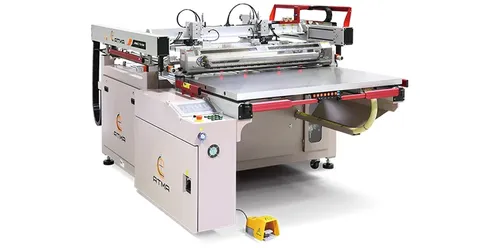
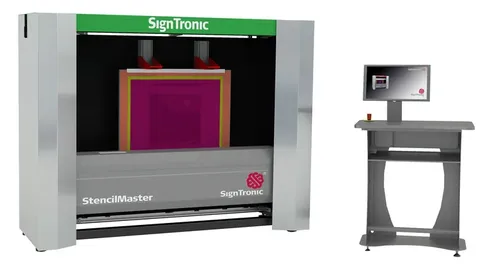
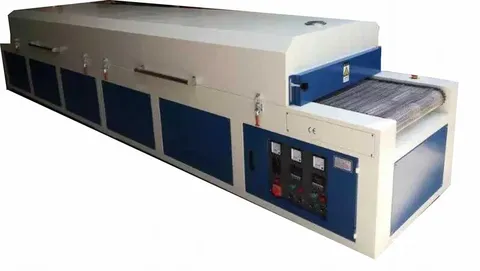
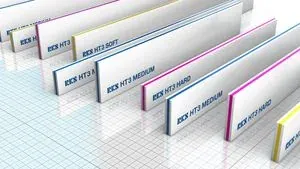
The press is one part of the line. See all printers, pre-press, dryers, handling, squeegees.
From Sunstar Academy
Real footage and short lessons from Sunstar's own channel.
All videos →
How Screen Printing Makes Electronic Circuits, Sensors & Membrane Switches
Did you know screen printing is used in electronics manufacturing, not just for printing graphics?
Questions buyers ask
Which screen printing machine is used for membrane switches?
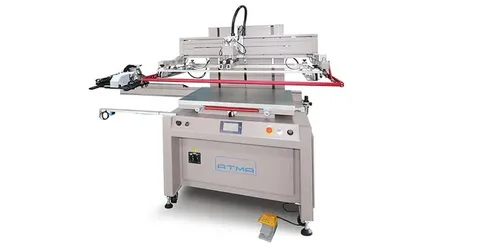
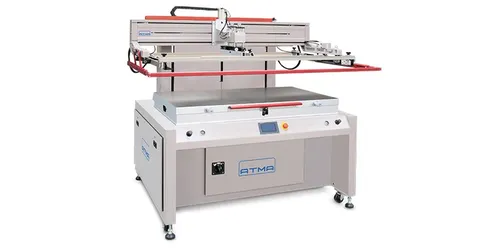
Flatbed presses such as the ATMA ATMACE 67/G(6), AT-80P/SV and AT-120P, on polyester and polycarbonate.
How long does setup take?
A stored job is recalled from the touchscreen. Typical changeover is under 30 minutes.
Also searched as
membrane keypad printing machine, graphic overlay printing machine, fascia printing machine, membrane switch printer, membrane switch printing machine, keypad printing machine, panel printing machine, overlay printing machine, control panel printing machine
Machine types for this job
See every model in each class.
Fully automatic flatbeds, cylinder presses and reel-fed printers
An automatic screen printing machine feeds the sheet, registers it, prints it and delivers it to the dryer without an operator handling each piece.
See models →Machine typeOperator-fed electric flatbeds and precision part printers
A semi-automatic screen printing machine prints each sheet by motor while an operator loads and unloads it.
See models →Machine typeFlat bed presses for rigid and flexible sheets up to 25 mm thick
A flatbed screen printing machine holds the sheet flat on a vacuum bed.
See models →Machine typeCamera-aligned presses for fine lines and multilayer printing
A CCD registration screen printing machine uses cameras to find register marks on the sheet or web before each print.
See models →Machine typePneumatic mesh stretching to a set, repeatable tension
A screen stretching machine pulls the mesh to a set tension in both directions and holds it while the mesh is glued to the frame.
See models →Machine typeAutomatic emulsion coating to the same thickness on every screen
A screen coating machine applies photo emulsion to the stretched mesh.
See models →Guides
Useful for this job.
All guides →Flatbed vs cylinder screen printing machine
Choose a flatbed if you print rigid or thick material, or mixed jobs in short and medium runs at around 500 sheets an hour. Choose a stop-cylinder press if you print thin flexible sheets in long runs and need 1,800 to 4,000 sheets an hour. Many plants run both.
Read →GuideHow to choose an industrial screen printing machine
Five facts about your job decide the machine: the material and its thickness, the print size, the output you need per hour, the register tolerance and the ink. With these in hand, the choice between a flatbed, a cylinder press, a roll-to-roll press or a purpose-built printer is usually clear.
Read →GuideImported vs Indian screen printing machine
A lower-cost Indian-made screen printing machine is a sensible choice for simple graphics, wide tolerances, short runs and a tight budget. A precision imported press earns its cost on multi-layer and functional work, tight register and high volume, where rejects are expensive. The tolerance of your part and the cost of a rejected sheet decide it.
Read →GuideScreen printing vs digital printing for industrial parts
Screen printing is the better process for volume production, for thick or opaque ink films and for functional inks such as silver, carbon and glass enamel. Digital printing is better for short runs, many design versions and variable data. It is common to use digital for samples and screen printing for production.
Read →GuideHow membrane switches are made
A membrane switch is made by screen printing a graphic overlay and one or two circuit layers on plastic film, then cutting them and laminating them with a spacer and adhesive. The circuit is printed in silver and carbon ink, with a dielectric layer for insulation. Each printed layer is dried or cured before the next, and each has to register to the others.
Read →GuideFine-line screen printing on polycarbonate
Fine lines on polycarbonate need four things to be right together: a fine mesh at high tension, a thin and flat stencil with a sharp image, a sharp squeegee at low pressure, and a clean, flat sheet free of static. Lines of around 100 to 150 microns are typically achievable on a well set flatbed press. Finer lines need closer control of every step.
Read →Related applications
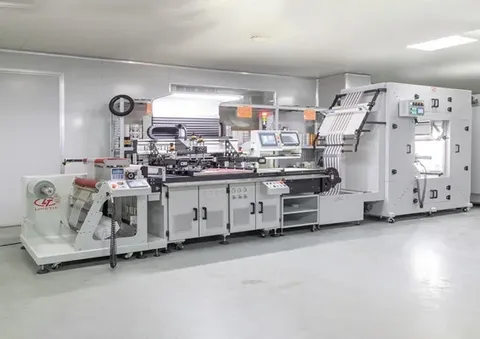
Flexible circuits (FPC)
Flexible circuits are printed on thin film that stretches and moves.
See the line →Electronics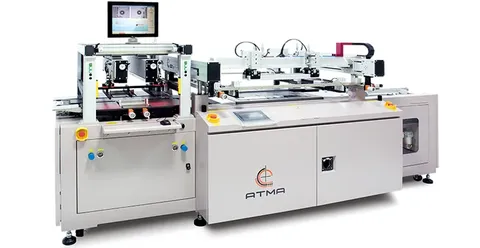
Rigid PCBs
Rigid boards are screen printed with solder mask, legend, carbon and peelable mask.
See the line →Electronics · Glass and solar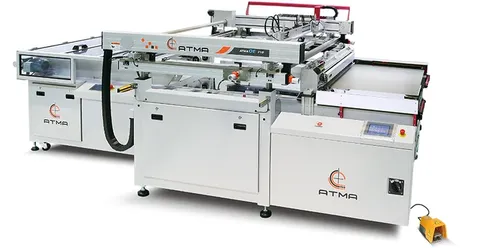
Touch panels and cover glass
Cover glass gets a printed border in black or white, with windows for cameras and sensors.
See the line →Inquiry
Tell Sunstar what you print.
An engineer replies within one working day with machine options and Indian pricing. Delivered and installed anywhere in India.