How a flatbed screen printing machine works
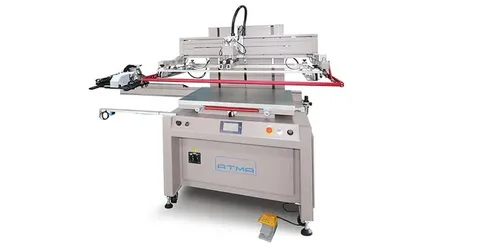
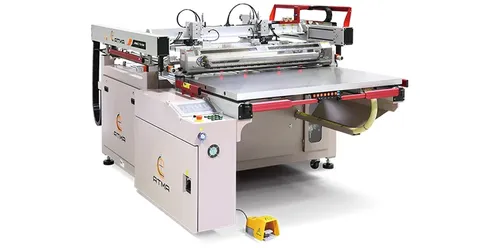
A flatbed (also written flat bed) screen printing machine holds the sheet flat on a vacuum bed. The screen comes down over the sheet and the squeegee travels across it, pushing ink through the mesh. The sheet stays still during the print.
Because the bed is flat, the material does not have to bend. A flatbed prints rigid and flexible sheets: polycarbonate, polyester, PVC, glass, metal and board. The ATMA flatbeds that Sunstar supplies take material up to 25 mm thick.
A semi-automatic flatbed typically prints around 500 sheets an hour. A fully automatic flatbed with a feeder prints more and needs less handling.
How a stop-cylinder screen printing press works
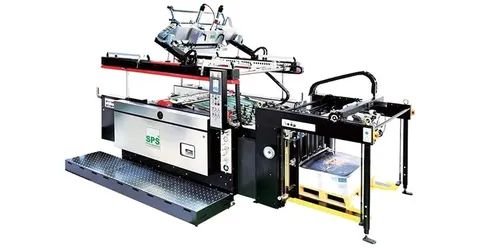
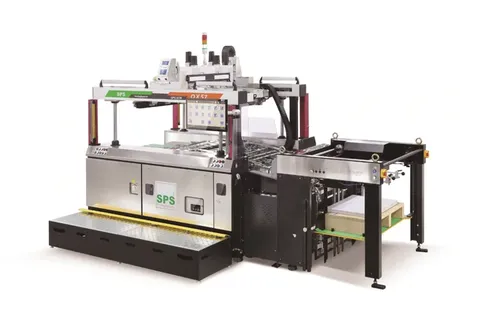
A stop-cylinder press grips the sheet on a cylinder. The cylinder turns while the screen moves over it. The squeegee stays in one place above the cylinder. The cylinder stops for each new sheet so that the sheet can be fed and registered, which gives the press its name.
Ink transfers along a thin line of contact and the sheet peels away from the screen at once. This gives a sharp print at high speed. Printed sheets leave on a conveyor and go straight into the dryer.
The sheet has to bend around the cylinder, so this press is for flexible material: paper, board, self-adhesive vinyl and plastic film. SPS stop-cylinder presses run at 1,800 to 4,000 sheets an hour, depending on the model and the sheet size.
In this guide a cylinder press means a sheet-fed press for flat sheets. Machines that print round bottles and containers are a different type.
Flatbed and cylinder press side by side
| Flatbed | Stop-cylinder press | |
|---|---|---|
| Material | Rigid and flexible sheets | Flexible sheets only |
| Thickness | Up to 25 mm on ATMA flatbeds | Thin sheet and film. Check the range of the model |
| Typical output | Around 500 sheets an hour, more with automatic feeding | 1,800 to 4,000 sheets an hour |
| Feeding | By hand or with a feeder | Automatic feeder and delivery |
| Run length | Short and medium runs with frequent job changes | Long runs |
| Typical jobs | Membrane switches, dials, nameplates, glass, PCBs | Decals, labels, spot UV, IMD films, security printing |
When a flatbed is the right choice
A flatbed is the more flexible of the two machines. It suits a plant where:
- The material is rigid or thick, such as glass, metal plate or heavy plastic sheet
- Jobs change several times a shift and runs are short
- One press has to take many different materials and sizes
- Output of a few hundred sheets an hour is enough
When a cylinder press is the right choice
A stop-cylinder press is built for output. It suits a plant where:
- The same job runs for thousands of thin, flexible sheets
- Output per hour decides the cost of each sheet
- Sheets should go from feeder to press to dryer to stacker without handling
- Multicolour work needs camera registration at speed. The SPS ASTRON QX registers to 30 microns with cameras
What Sunstar supplies
Sunstar Graphics is the exclusive distributor in India for ATMA flatbed screen printers from Taiwan and SPS stop-cylinder presses from Germany. Sunstar supplies, installs and services both from Mumbai, across India, and trains your operators.
Send an enquiry with your material, sheet size and the output you need per hour. Sunstar replies within one working day. You can ask for machine options and Indian pricing for a flatbed, a cylinder press or both.