
Application · Automotive
Gasket screen printing machine
Gasket coating and sealing beads. Gaskets get a printed sealing bead or coating in silicone or elastomer. The deposit is heavy and has to sit exactly on the sealing line.
- Cylinder head and manifold gaskets
- Sealing beads on metal and fibre gaskets
- Coated shims
Steel, composite and fibre gasket sheet
- Heavy, even deposit
- Accurate bead position
- Handling of stamped parts
A typical Sunstar line
These machines are commonly specified together for this job. Sunstar confirms the final line against your material, print size and volume.
All machines →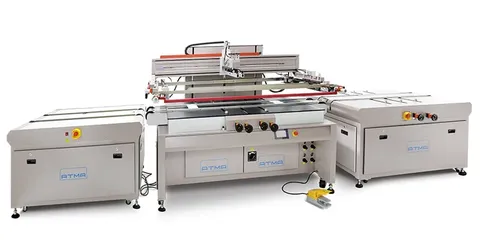
The press is one part of the line. See all printers, pre-press, dryers, handling, squeegees.
Questions buyers ask
Is there a dedicated machine for gasket printing?
Yes. The ATMATIC GD series is built for gasket bead printing, with part handling and a heavy-deposit print head.
Also searched as
gasket printing machine, gasket bead coating machine, silicone bead screen printing, gasket coating machine, sealant bead printing machine, gasket silicone printing machine, head gasket printing
Machine types for this job
See every model in each class.
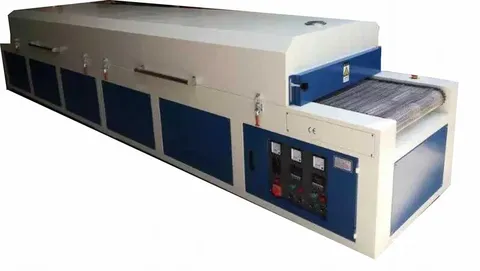
Infrared hot-air tunnels for solvent, water-based and conductive inks
An IR hot-air conveyor dryer carries the printed sheet on a belt through a heated tunnel.
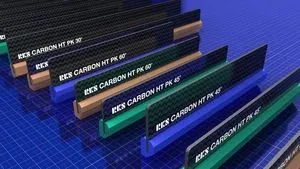
See models →Machine typeRKS and Kuroki squeegee blades, RKS holders and ATMA squeegee sharpeners
The squeegee blade pushes ink through the open mesh onto the sheet.
See models →Guides
Useful for this job.
All guides →Squeegee pressure, angle and hardness
Squeegee pressure, angle and hardness together decide how much ink passes through the screen and how sharp the printed edge is. Use the lowest pressure that gives a complete print, an angle of about 70 to 75 degrees as a starting point, and a blade of 70 to 75 Shore A for general work. A softer blade, a flatter angle and a slower stroke all put down more ink.
Read →GuideEmulsion thickness (EOM)
EOM, or emulsion over mesh, is the thickness of emulsion that stands beyond the mesh on the print side of the screen. For fine lines and halftones it is typically 3 to 8 microns, or about 10 to 20 percent of the mesh thickness. EOM is set by how the screen is coated: the number of coats, the side they are applied from, the coating speed and the trough.
Read →Related applications
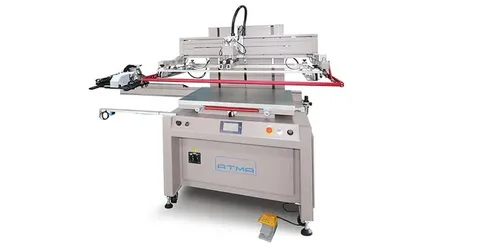
Dials and clusters
Dials and instrument cluster appliqués are printed in six to twelve layers on polycarbonate.
See the line →Automotive · Plastic and metal parts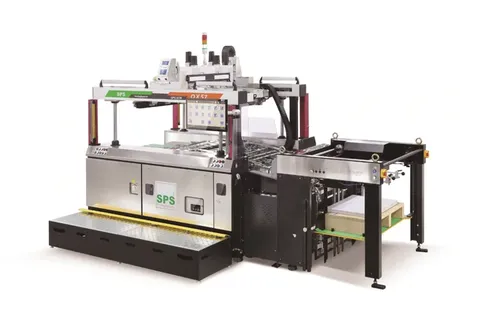
IMD / in-mould decoration
IMD films are screen printed flat, then formed and back-moulded into a plastic part.
See the line →Automotive · Labels, nameplates and packaging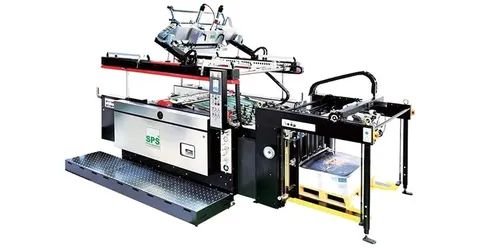
Vehicle decals and graphics
Two-wheeler and vehicle graphics are printed in long runs on self-adhesive vinyl, in several colours plus a clear coat.
See the line →Inquiry
Tell Sunstar what you print.
An engineer replies within one working day with machine options and Indian pricing. Delivered and installed anywhere in India.