What differs between the two
India has many makers of screen printing machines, from manual tables to semi-automatic and automatic presses. These machines cost less to buy, are delivered from within the country, and the maker is close by for spares.
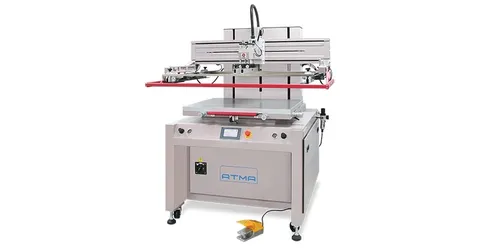
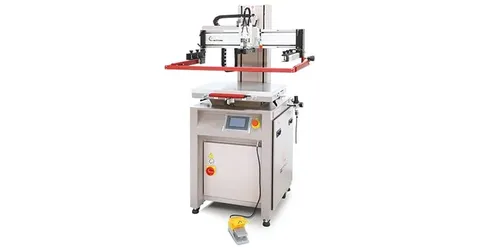
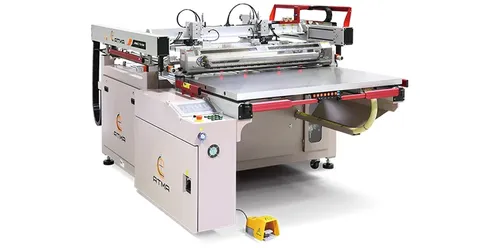
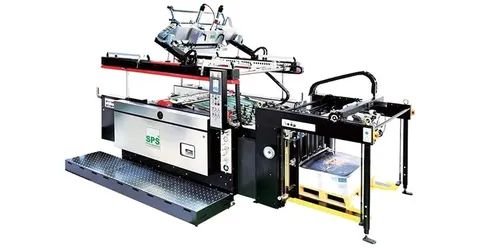
Imported precision presses come from specialist makers in Taiwan, Germany, Switzerland and other countries. They cost more, and customs duty and freight add to the landed cost. What the buyer pays for is repeatability: each print lands in the same place with the same ink deposit, from the first sheet of the run to the last.
Build quality varies within both groups. Compare individual machines on their stated figures and on a print trial, whichever country they come from.
Indian-made and imported machines side by side
| Lower-cost Indian-made machine | Precision imported press | |
|---|---|---|
| Purchase cost | Lower | Higher, with duty and freight added |
| Delivery | From within India | Shipped from the maker. Ask for the delivery period in the quotation |
| Spares and service | The maker is in India | Through the Indian distributor. Ask who holds spares and who services |
| Register and repeatability | Varies by maker. Ask for the stated figure | Stated by the maker, for example ±0.02 mm repeat accuracy on ATMA flatbeds |
| Best suited to | Simple graphics, short runs, wide tolerances | Multi-layer, fine-line and functional printing in volume |
Where an Indian-made machine is the sensible choice
A lower-cost machine is the sensible choice for the work listed below. Here a costlier press will not make a better product, and the money is better spent on good screens, good ink and a proper dryer.
- One-colour or simple multicolour graphics, where a small register shift does not cause a reject
- Short runs and occasional printing, where the machine stands idle for part of the week
- New units and trial products, where the market is still being proved
- Work where the ink film thickness does not affect how the product functions
- Budgets that would otherwise only stretch to a manual table
Where a precision imported press earns its cost
For the work listed below, add up the cost over the life of the machine: rejected sheets, wasted ink and substrate, setup time and stoppages. A press that holds register and deposit can recover its higher price through lower rejection. Work the numbers for your own job.
- Multi-layer parts such as dials, membrane switches and IMD films, where six to twelve passes have to register to each other
- Functional printing with silver, carbon and dielectric inks, where the ink film sets the electrical value of the part
- Fine lines and small text that have to stay sharp through the run
- High volume, where even a small rejection rate is a large number of sheets
- Supply to automotive, electronics and medical customers who audit the process and expect the same result in every batch
How to compare any two machines
- Ask for the stated repeat accuracy and how it is measured
- Ask for a sample print or trial on your own material and artwork
- Ask who installs the machine, who trains the operators and where spares are held
- Compare the landed cost of the imported machine, with duty, freight, GST and installation, against the full price of the Indian machine
What Sunstar supplies
Sunstar Graphics supplies the imported side of this choice. It is the exclusive distributor in India for ATMA (Taiwan), SPS (Germany), Grünig and SignTronic (Switzerland), RKS (Germany), Lingtie (China) and Luen Cheong (Hong Kong). It also supplies Kuroki squeegees from Taiwan. The range runs from compact semi-automatic flatbeds to fully automatic lines.
Sunstar installs each machine, trains operators and services it from Mumbai, across India, and has installed more than 400 machines. If your work is in the first list in this guide, an Indian-made machine may serve you well. If it is in the second list, send an enquiry with your job details. Sunstar replies within one working day, and you can ask for machine options and Indian pricing.