What semi-automatic means
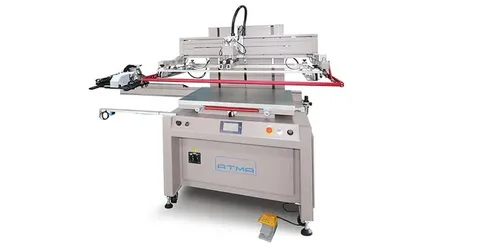
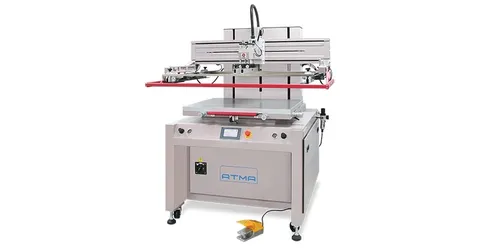
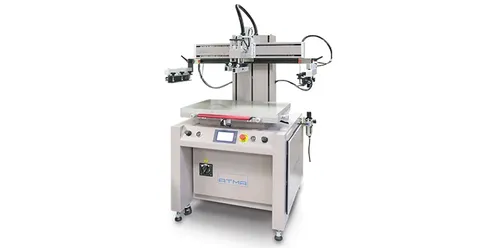
On a semi-automatic (also written semi automatic or semi-auto) screen printing machine, the operator places the sheet on the bed against register stops. The machine lowers the screen, floods, prints and lifts. The operator then removes the sheet and puts it on the dryer belt or a rack.
Output depends on the operator. The machine cycle may allow around 500 prints an hour, but hand loading over a full shift is usually slower than that.
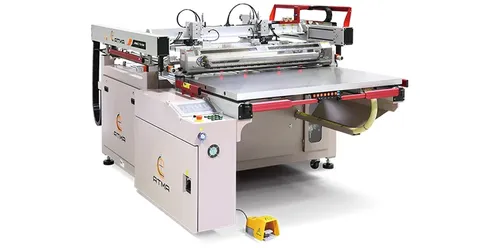
Some semi-automatic flatbeds have an automatic take-off. The operator loads by hand, and vacuum cups lift the printed sheet onto the dryer conveyor. This is often called a three-quarter automatic machine. The ATMA AT-80P/SV works this way.
What fully automatic means
A fully automatic screen printing machine feeds each sheet from a stack, registers it, prints it and delivers it to the dryer without being touched. With a dryer and a stacker it becomes a complete printing line. One operator watches the line, tops up ink and loads the stacks.
Fully automatic machines come in several forms: automatic flatbeds with a feeder, stop-cylinder presses that run at 1,800 to 4,000 sheets an hour, and roll-to-roll presses that print from reel to reel.
Semi-automatic and fully automatic compared
| Semi-automatic | Fully automatic | |
|---|---|---|
| Loading and unloading | By hand, or hand loading with automatic take-off | Automatic feeder and delivery |
| Output | Set by the operator, typically up to about 500 sheets an hour | Set by the machine and steady through the shift |
| Operators | One at each press, sometimes a second at the dryer | One for the whole line |
| Job change | Quick | Longer, because the feeder and delivery are also set |
| Material | Almost any sheet, rigid or flexible, thick or thin | Sheets or reels that the feeder is built to handle |
| Purchase cost | Lower | Higher |
How to decide
Five things settle the choice.
- Volume per job. If the same job runs for a full shift or longer, automatic feeding pays back. If a job is a few hundred sheets, most of the time goes in setup and a semi-automatic press is enough
- Job changes. A plant that changes jobs many times a day gains little from a feeder that has to be reset each time
- Material. Thick, heavy or odd-sized pieces are easier to load by hand. Thin film in volume is handled better by a feeder, with fewer scratches and finger marks
- Consistency. A feeder places every sheet the same way, which helps register on multicolour and multi-layer work
- Labour. A fully automatic line needs fewer people for each thousand sheets, and the output does not fall late in the shift
Match the dryer to the press
Whichever you choose, the dryer has to keep up with the press. A fully automatic press that feeds a short dryer has to run slowly. Size the IR or UV dryer for the sheet width and for the output per hour you plan.
A common path is to start with a semi-automatic flatbed with vacuum take-off, then add a fully automatic machine when one product reaches steady volume.
What Sunstar supplies
Sunstar Graphics supplies both classes. Semi-automatic machines include ATMA electric flatbeds such as the AT-80P and the AT-80P/SV with vacuum take-off. Fully automatic machines include ATMA automatic flatbeds such as the ATMACE 67/G(6) and AT-60FA, SPS stop-cylinder presses and Lingtie roll-to-roll presses. Luen Cheong IR and UV dryers are sized to the press.
Sunstar is the exclusive distributor in India for these brands, and installs and services the machines from Mumbai, across India. Send an enquiry with your material, sheet size and volume per shift. Sunstar replies within one working day, and you can ask for machine options and Indian pricing for both levels of automation.