What N/cm means and typical values
N/cm is the force, in newtons, pulling on each centimetre of mesh width. A higher figure means a tighter screen. Thick threads carry more force than thin threads, so coarse meshes are usually stretched tighter than fine meshes.
The values below are typical for industrial screens. Use them as a starting point and confirm the figure in the mesh maker's data sheet, because standard and low-elongation meshes of the same count differ.
| Mesh | Typical tension | Used for |
|---|---|---|
| Coarse polyester, up to about 60 threads per cm | 22 to 30 N/cm | Heavy deposits, textured varnish, gasket beads |
| Medium polyester, 77 to 120 threads per cm | 20 to 28 N/cm | Solids, conductive inks, general graphics |
| Fine polyester, 140 to 180 threads per cm | 16 to 24 N/cm | Fine lines, halftones, dial scales |
| Stainless steel mesh | 25 to 35 N/cm or more | Very fine functional printing |
How to measure screen tension
Use a mechanical or electronic tension meter, also called a newton meter. Check its zero on the glass plate supplied with it before each session. A good screen reads within about 1 to 2 N/cm across all points and in both directions.
- Lay the frame flat with the mesh facing up and nothing touching it from below.
- Place the meter at least 10 cm in from the frame edge.
- Take one reading along the warp and one along the weft at each point.
- Measure five points: the centre and near each corner. On large frames measure nine.
- Write the readings on the frame or in the screen record.
Tension loss after stretching
Mesh relaxes after it is stretched. A screen can lose 10 to 20 percent of its tension in the first day, and a little more over its first few print runs. Stretching in stages, with a pause between each stage, reduces this loss. Good practice is to let a glued screen rest for 24 hours and measure it again before coating.
Measure each screen again after every reclaim. Set a lower limit for your work, and restretch or retire screens that fall below it.
What low or uneven tension does on the press
For multicolour jobs, keep every screen in the set within about 2 N/cm of the others, on the same frame size and the same mesh.
- The mesh lifts slowly behind the squeegee, so the print smears or shows mesh marks.
- The operator raises the off-contact to get release, and the image stretches.
- Colours go out of register because each screen stretches by a different amount.
- Ink deposit changes between the centre of the image and the edges.
Screen stretching machines Sunstar supplies
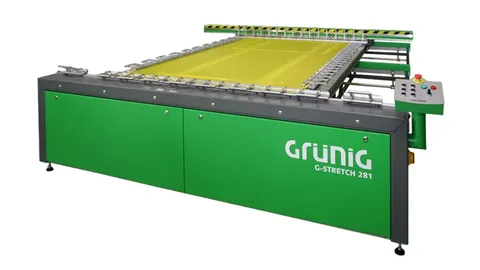
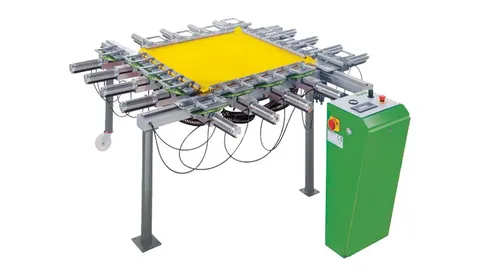
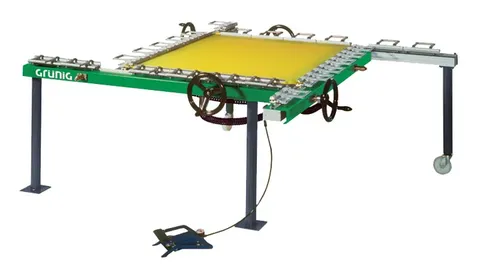
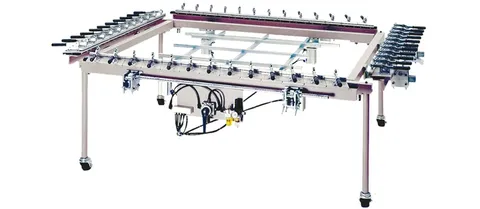
Sunstar Graphics supplies Grünig screen stretching machines from Switzerland in India. The G-STRETCH 281, G-STRETCH 215 and G-STRETCH 210 stretch the mesh pneumatically to a set tension, which helps every screen in a set reach the same value. Grünig G-GATEWAY software logs each screen. The ATMA A-211 is a screen fabric stretcher from ATMA.
Sunstar installs the machine, trains your operators and services it from Mumbai. Send an enquiry with your frame sizes and screens per day for machine options and Indian pricing.