What EOM and Rz mean
A coated screen has emulsion inside the mesh openings and a thin layer beyond the threads on the print side, the side that faces the substrate. That extra layer is the EOM. Measure the dry stencil with a thickness gauge and subtract the thickness of the bare mesh. The difference is the EOM.
Rz is the roughness of the stencil surface on the print side. A smooth surface seals against the substrate like a gasket, so ink cannot creep sideways. A rough surface follows the mesh threads and prints a sawtooth edge.
Typical EOM by type of work
These are typical values. The emulsion maker's data sheet gives coating sequences for each mesh, and the ink maker's data sheet gives the film thickness to aim for.
| Work | Typical EOM |
|---|---|
| Halftones and fine lines | 3 to 8 microns, about 10 to 20 percent of mesh thickness |
| General line work and solids | 8 to 15 microns |
| Conductive tracks and dielectric | Set from the dry film the paste needs, commonly 10 to 25 microns |
| High-build work: textured UV, braille, gasket beads | 50 microns to several hundred, with thick-film emulsion or capillary film |
Too little and too much
In large solid areas the mesh sets most of the deposit. EOM matters most at edges, lines and dots.
- Too little EOM: sawtooth edges, ink bleeding under the stencil, short stencil life.
- Too much EOM: heavy deposit at line edges, fine lines and dots that do not release, longer exposure and a risk of under-exposure.
- Uneven EOM across the screen: deposit and colour vary from one side of the print to the other.
How screen coating controls EOM
Emulsion is applied wet-on-wet with a coating trough. Coats from the print side fill the mesh. Coats from the squeegee side push emulsion through and build the layer on the print side. The screen is then dried horizontally with the print side down. Extra face coats on the dried print side lower the Rz.
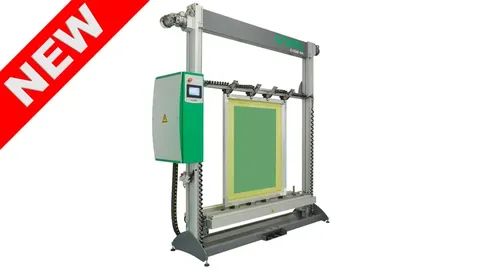
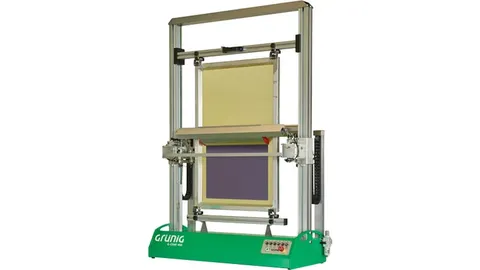
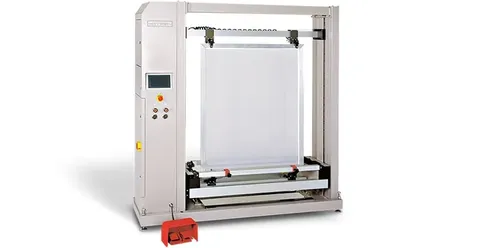
The result changes with coating speed, trough angle, trough pressure, the radius of the trough edge, the solids content of the emulsion and the mesh count. With hand coating these change from operator to operator. An automatic screen coating machine, also called an emulsion coating machine, coats at a set speed and pressure with a set number of coats on each side. A thicker stencil needs more exposure, so run an exposure step test whenever the coating recipe changes.
Screen coating machines Sunstar supplies
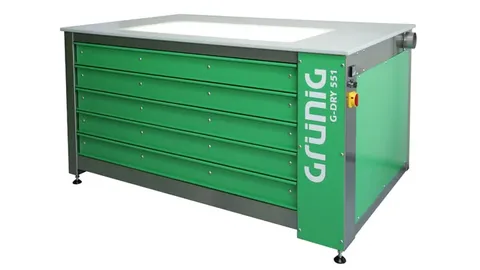
Sunstar Graphics supplies Grünig screen coating machines from Switzerland in India. The G-COAT 414 is an automatic coating machine. The G-COAT 406 and G-COAT 404 are further coating machines in the range, and the G-COAT 401 is a coating trough. Grünig coaters apply emulsion to a repeatable thickness. ATMA offers the C 1012 / C 1016 screen coating machine, and the Grünig G 551 and G 571 stencil dryers dry the coated screen.
Send an enquiry with your frame sizes and screens per day for machine options and Indian pricing.