Typical mesh for conductive and dielectric inks
These are typical choices. Mesh makers write a mesh as count and thread diameter. For example, 77-48 means 77 threads per cm with a 48 micron thread.
| Layer | Typical mesh | Notes |
|---|---|---|
| Silver tracks, lines of 300 microns and wider | Polyester, 61 to 90 threads per cm | The common choice for membrane switch circuits |
| Carbon pads and resistors | Polyester, 61 to 90 threads per cm | Resistance follows film thickness closely |
| Fine silver lines, under about 150 microns | Stainless steel, 325 to 400 threads per inch, or fine polyester | Needs a thin, flat stencil |
| Dielectric and insulation ink | Polyester, 77 to 120 threads per cm | Often printed in two layers to close pinholes |
| Silver / silver chloride and biosensor carbon | As the paste data sheet states | Electrode area and thickness set the reading |
What the mesh decides
Mesh count and thread diameter together set the theoretical ink volume, which mesh makers publish in cm³ per m². That volume sets the wet film. The wet film sets the dry film, and the dry film sets the resistance of the track. Two meshes with the same count and different thread diameters give different deposits.
A coarser mesh gives a thicker track with lower resistance and uses more silver. A finer mesh saves paste and prints narrower lines, with higher resistance. The mesh opening should also be at least about three times the largest particle in the paste, or flakes will block the mesh.
Polyester or stainless steel mesh
Polyester mesh costs less, survives handling and suits most membrane switch and sensor work. Stainless steel mesh has thinner wires and a larger open area for the same count. It holds its size better and takes higher tension, so it suits fine lines and tight tolerances. It costs more, and a dent in it is permanent.
Stencil, print and drying
- Keep the stencil thin and flat for fine lines. Thick emulsion adds deposit at the line edges.
- Stretch the mesh at an angle, commonly 22.5 degrees, so tracks do not run along the threads.
- Use an emulsion that resists the solvents in the paste.
- Hold squeegee speed and pressure constant. A change in either changes the resistance.
- Dry to the time and temperature in the paste data sheet. Under-dried silver reads high.
- Print a test track on every sheet and measure its resistance.
Machines Sunstar supplies for conductive ink printing
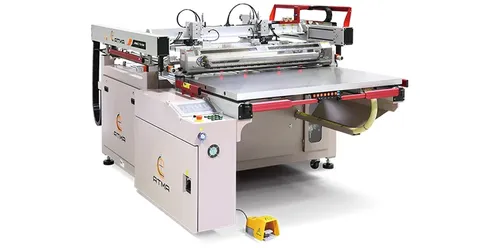
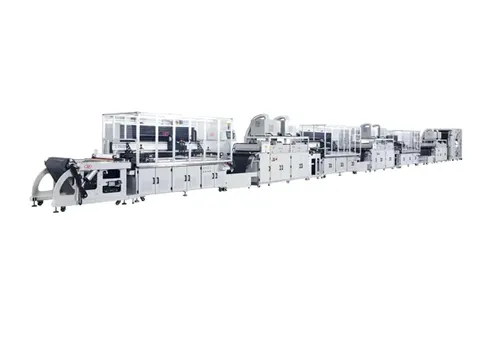
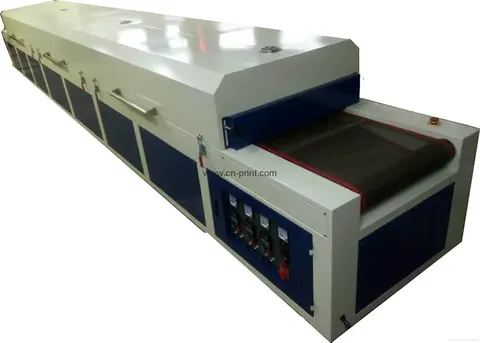
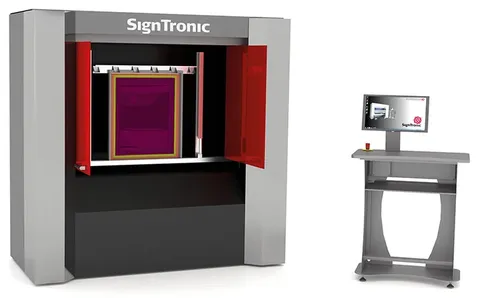
The press has to lay down the same film on every sheet. ATMA flatbed screen printers, which Sunstar Graphics supplies in India, use a servo print stroke and a motor-driven vertical screen lift. The ATMACE 67/G(6) is a fully automatic flatbed with a feeder. For work on the reel, the Lingtie LTA-80200 is a fully automatic roll-to-roll (reel to reel) screen printer. Luen Cheong IR hot-air drying tunnels such as the LC-SD 7000 dry the paste in line, and the SignTronic STM MICRO images fine-line screens without film.
Send an enquiry with your paste, substrate and line width for machine options and Indian pricing.